
Everest Base Camp Trekking
Starts From $1999
For 0-1 People
$1999
/PersonFor 2-5 People
$1899
/PersonFor 6+ People
$1799
/PersonKey Highlights
- Admiring the breathtaking Himalayan panoramas
- The Sherpa, their culture, and their traditions are treasured.
- The Buddhist monasteries, bright prayer flags, and distinctive carvings on the walls will make you fall in love.
- Enjoy the welcoming warmth of the Himalayan natives.
- Tengboche is an old and culturally significant monastery.
- One of the top hiking trails in the world awaits you.
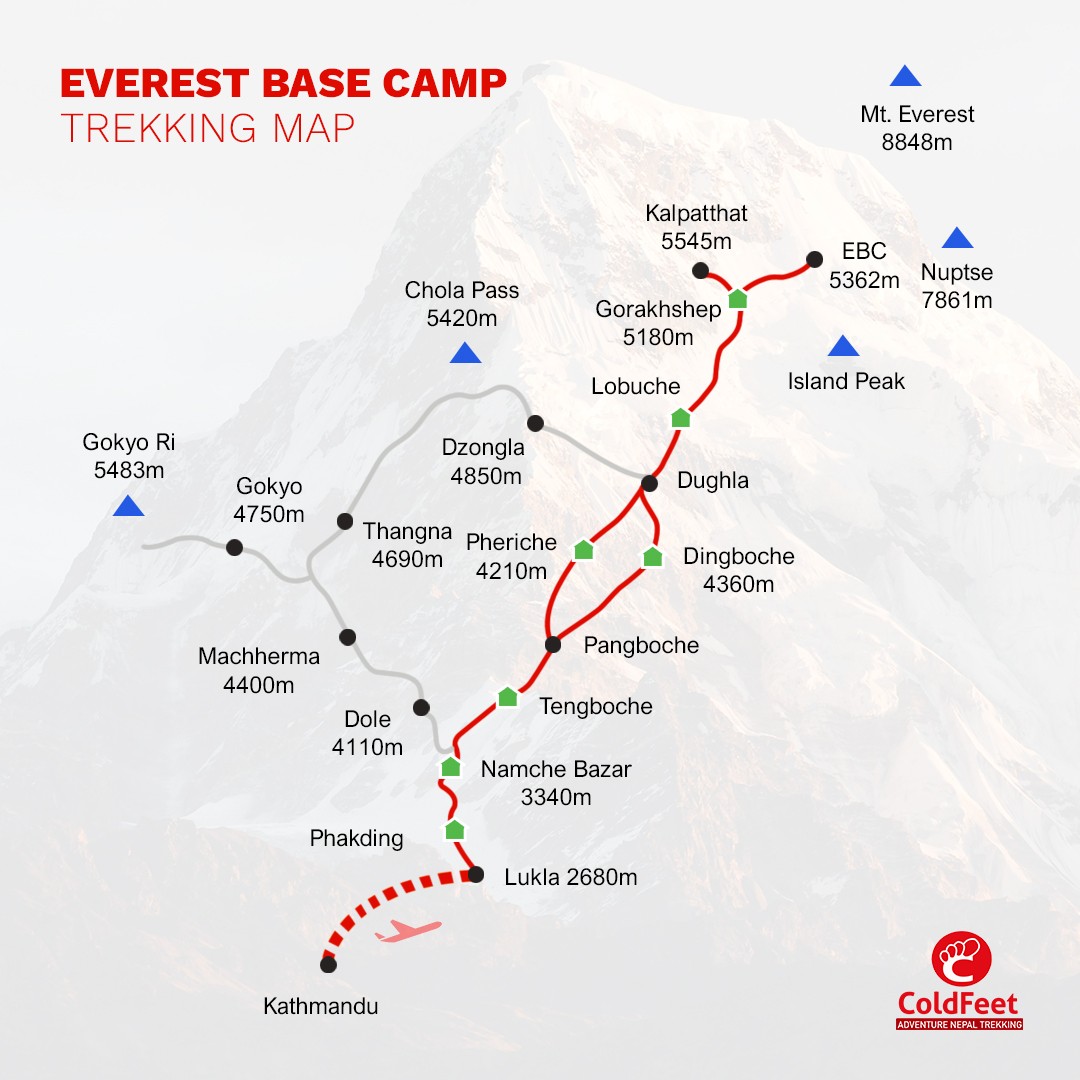
Trekking Map
Need Assistance?
+977 987 654 3210
support@example.com
Package Overview
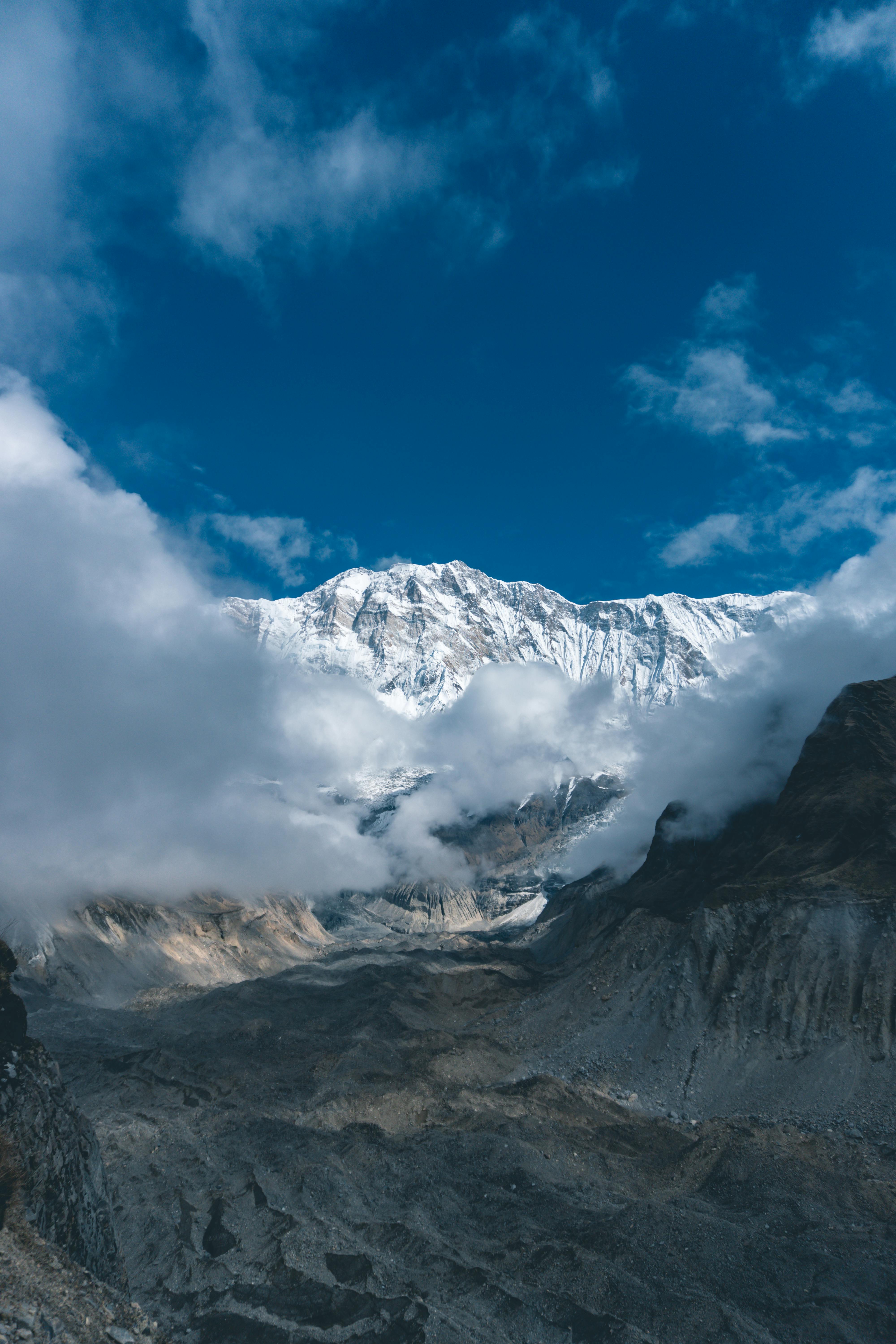
Mount Everest is the highest peak of the world and every adventure lovers have their dream to touch the apex of Everest or to reach at the lap of this glorious height. Everest Base Camp Trek is one of the most frequently organized trekking packages by ColdFeet Adventure Nepal. For sure, Everest Base Camp Trek will let you experience the land and surroundings of the base of Mount Everest and you will really feel great by trekking that region. Everyone is going to enjoy the incredible views and rewards by stepping in the region. EBC Trek will let you experience the unique cultural heritage of legendry Sherpa people along with the amazing flora and fauna. Everest Base Camp Trekking trail will pass through the Sherpa villages which are interspersed with magnificent forests of rhododendron and magnolia. And the trail begins from Kathmandu to Lukla flight and then Lukla will be the starting point for our actual trekking. You will get a chance to visit the famous viewpoint Kalapatthar which is located at the altitude of 5550m during this trek. In addition to Mount Everest we will also enjoy the stunning views of Mount Lhotse, Mount Nupse, Mount Pumori, Mount Lingtring, Mount Thamserku, Mount Ksumakagru, Mount Amadablam, and many others. ColdFeet Adventure Nepal is always ready for guiding you this awesome trekking of Everest Base Camp. We have designed very customizable itineraries for this trek. We guarantee your satisfaction.
Core Features
14 Days
Duration
5554m/18192ft
Max. Altitude
Moderate
Grade
1-16 People
Group Size
Itinerary
Day 1: Arrival at Kathmandu Airport
On the very first day, our first meeting will be at Tribhuvan International Airport where one of our representatives will be waiting for you. Then we will be heading towards the hotel where you will attend the trip briefing session. The details will be regarding the trek preparation. Hence, the first day will end with the overnight stay in Kathmandu.
Day 2: Sightseeing in Kathmandu
After breakfast at the hotel, we will further move for sightseeing after the guide will come to fetch you at the hotel. There are four destinations for sightseeing that are enlisted in UNESCO World Heritage Sites. The first destination will be Pashupatinath, the biggest Hindu Temple where you will feel a mystical delight. Then you will set out towards Boudhanath Stupa which is the biggest stupa of South Asia. The huge mandala structure contains a giant stupa at its center, decorated with prayer flags, the site will call your inner peace. The next site is Swayambhunath, more popular as Monkey Temple among tourists. The temple premises is a good viewpoint to observe the entire valley and sunset in the evening. Today’s final destination is Kathmandu Durbar Square. Another name for this world-famous UNESCO World Heritage site is Hanuman Dhoka Durbar Square or Basantapur Durbar. It houses dozens of temples with unique wooden craft, centuries-old buildings preserving the cultures from the early 6th century. Kathmandu Durbar Square is a religious, historical, and cultural center of Nepal.
Migration & Implementation
Seamless transition with minimal disruption to your ongoing operations.
Support & Optimization
Continuous monitoring, maintenance, and optimization to ensure peak performance.
Map
Photos

FAQ's
1 What are the Major Trekking Route in Everest Region?
There are many trekking routes in the Everest Region. Most of them begin with a short flight from Kathmandu takes you to Lukla. You trek uphill making your way past the Phakding to reach Namche Bazaar. From here, the trekking route depends upon the trek that you choose. The Everest Base Camp follows the route along Tengboche, Pangboche, Pheriche, Thukla, Lobuche, and Gorakshep to reach the Everest Base Camp. A number of treks follow this route either fully or in parts. Everest Panorama Trek, Everest Base Camp Luxury Trek, and EBC Cho La Pass Trek are a few examples. Similarly, another trekking route heads northwest to Thame and Lumde to cross Renjo La Pass (5360m) and reach Gokyo. Thereon, the route continues west and crosses Cho La Pass (5420m) to reach Lobuche and rejoins the EBC Trail. Another trekking route begins at Jiri and explores the Rolwaling region to reach Lukla and continue the trek from there. As such, there are many trekking routes in the Everest region.
2 Which is the Best season to trek in Everest Region?
The question about what the best time to trek Everest Region completely depends upon the experience that you are looking for. However, there are two major seasons for trekking they are Pre-monsoon/Spring (February, March, April) and Post-Monsoon/autumn(Late September, October, November). The temperature is perfectly mild and skies are much clearer giving the best possible view of the mountain ranges around. Also during these seasons the flora and fauna come to life. You get the opportunity to see the exotic wild species like snow leopard and blue sheep and also enjoy the beauty of hills covered with wildflowers. However, at high altitude, the weather always remains unpredictable. So expect the unexpected.
3 Is there any risk of getting altitude sickness?
Located in a region susceptible to high altitude, the Everest trekking route is one of the most famous and highest trekking routes in the world. Typically it starts at an elevation of 2,840m in Lukla Airport and reaches the highest point of over 5,545m at Kalapatthar, the entire trek occurs in the two altitude regions: ‘high altitude’ and ‘very high altitude’. Therefore, there is a high chance of suffering from AMS and its better to look out for symptoms. The major symptoms include nausea, vomiting, dizziness, and restlessness.
1 Ac odio tempor orci dapibus ultrices in iaculis?
Molestie a iaculis at erat pellentesque adipiscing commodo. Dignissim suspendisse in est ante in. Nunc vel risus commodo viverra maecenas accumsan. Sit amet nisl suscipit adipiscing bibendum est. Purus gravida quis blandit turpis cursus in.
2 Tempus quam pellentesque nec nam aliquam sem et tortor consequat?
Laoreet sit amet cursus sit amet dictum sit amet justo. Mauris vitae ultricies leo integer malesuada nunc vel. Tincidunt eget nullam non nisi est sit amet. Turpis nunc eget lorem dolor sed. Ut venenatis tellus in metus vulputate eu scelerisque.
Molestie a iaculis at erat pellentesque adipiscing commodo. Dignissim suspendisse in est ante in. Nunc vel risus commodo viverra maecenas accumsan.
3 Varius vel pharetra vel turpis nunc eget lorem dolor?
Laoreet sit amet cursus sit amet dictum sit amet justo. Mauris vitae ultricies leo integer malesuada nunc vel. Tincidunt eget nullam non nisi est sit amet. Turpis nunc eget lorem dolor sed. Ut venenatis tellus in metus vulputate eu scelerisque.
1 Tortor vitae purus faucibus ornare suspendisse sed nisi lacus?
Feugiat pretium nibh ipsum consequat. Tempus iaculis urna id volutpat lacus laoreet non curabitur gravida. Venenatis lectus magna fringilla urna porttitor rhoncus dolor purus non.
Dignissim suspendisse in est ante in. Nunc vel risus commodo viverra maecenas accumsan. Sit amet nisl suscipit adipiscing bibendum est.
2 Tortor dignissim convallis aenean et tortor at risus viverra?
In hac habitasse platea dictumst vestibulum rhoncus est pellentesque. Dictumst vestibulum rhoncus est pellentesque elit ullamcorper. Non diam phasellus vestibulum lorem sed. Platea dictumst quisque sagittis purus sit.
3 Venenatis urna cursus eget nunc scelerisque viverra mauris in?
Mauris ultrices eros in cursus turpis massa tincidunt dui. Pellentesque nec nam aliquam sem et tortor. Habitant morbi tristique senectus et netus et malesuada.
Eleifend mi in nulla posuere sollicitudin aliquam ultrices sagittis orci. Faucibus pulvinar elementum integer enim. Sem nulla pharetra diam sit amet nisl suscipit.